Moroccan Military Forum alias FAR-MAROC
Royal Moroccan Armed Forces Royal Moroccan Navy Royal Moroccan Air Forces Forces Armées Royales Forces Royales Air Marine Royale Marocaine
|
| | | Chinese J-15 Carrier-borne Fighter |  |
| | | Auteur | Message |
|---|
MAATAWI
Modérateur


messages : 14755
Inscrit le : 07/09/2009
Localisation : Maroc
Nationalité : 
Médailles de mérite :


| Sujet: Chinese J-15 Carrier-borne Fighter  Lun 25 Avr - 10:20 Lun 25 Avr - 10:20 | |
| | |
| | | | Invité
Invité
| | Sujet: Re: Chinese J-15 Carrier-borne Fighter Lun 25 Avr - 11:39 | |
| |
| | | | ardogan
1ere classe


messages : 87
Inscrit le : 21/10/2010
Localisation : in the sky
Nationalité :
| | Sujet: Re: Chinese J-15 Carrier-borne Fighter Lun 25 Avr - 21:01 | |
| plutôt le SU-33 flanker navalisé ! une réplique de plus | |
| | | | MAATAWI
Modérateur
messages : 14755
Inscrit le : 07/09/2009
Localisation : Maroc
Nationalité :
Médailles de mérite :
| | Sujet: Re: Chinese J-15 Carrier-borne Fighter Mer 27 Avr - 8:45 | |
| | |
| | | | MAATAWI
Modérateur
messages : 14755
Inscrit le : 07/09/2009
Localisation : Maroc
Nationalité :
Médailles de mérite :
| | Sujet: Re: Chinese J-15 Carrier-borne Fighter Ven 24 Juin - 10:31 | |
| - Citation :
China’s J-15 No Game Changer

Following is a guest entry from Gabe Collins and Andrew Erickson, co-founders of China Sign Post.
Gen. Chen Bingde, Chief of Staff of the People’s Liberation Army (PLA), has reportedly said that, for the first time, a Chinese ‘aircraft carrier is under construction.’ China is also already preparing the refitted ski-jump carrier Varyag, purchased from Ukraine in 1998, to go to sea.
Given these developments, it seems a good time to look at the first carrier-based aircraft that China will employ: the new J-15 ‘Flying Shark’ carrier-based heavy fighter-bomber.
As currently configured, the J-15 is no ‘great leap forward,’ but is nevertheless triggering concern in the region because it indicates rapid improvement in Chinese naval aviation, and suggests Chinese determination to extend its regional blue water presence. The J-15’s initial role will be linked to, and limited by, its first operational platform: a ‘starter carrier’ to project a bit of power, confer prestige on a rising great power, and master basic procedures.
What’s Happening Now?
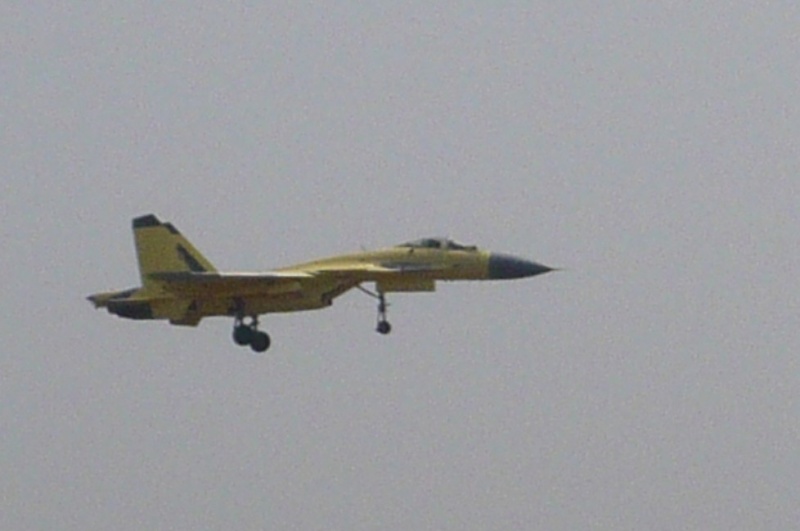
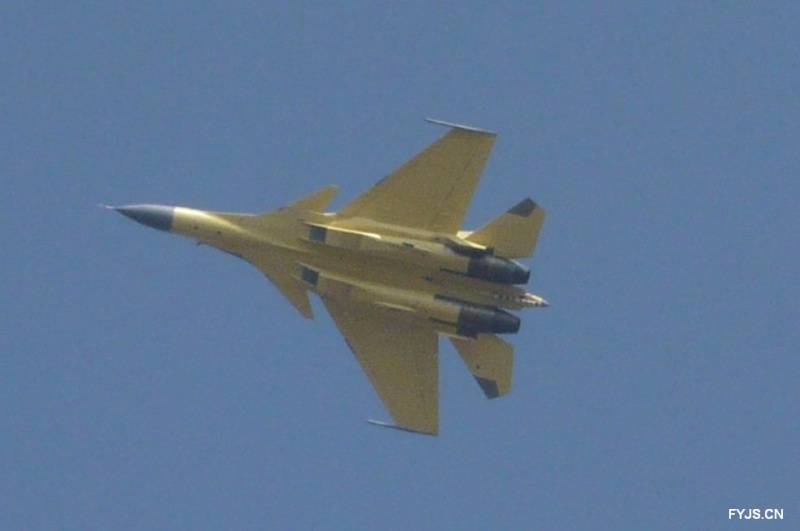
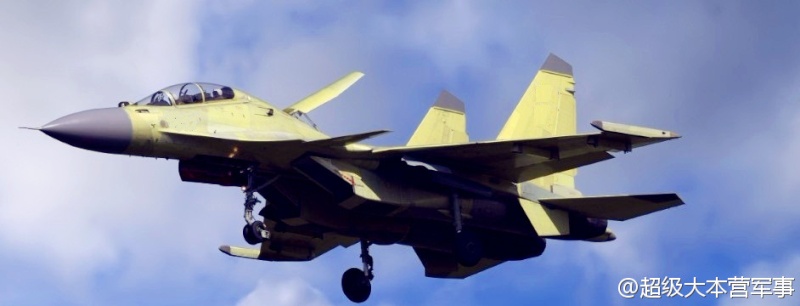
On April 24, 2011, Chinese Internet sources posted new photos of a J-15 sitting outside a hangar at the No. 112 Factory of Shenyang Aircraft Corporation airfield.
The J-15, which has an airframe closely resembling that of the Russian Su-33, boasts more advanced, indigenously made avionics, including a shortened tailcone, an arresting hook, and strengthened landing gear.
The lack of a second seat in the J-15 suggests that the PLA believes its electronics suite is sufficiently integrated and automated to require only one person to operate it, which is normal practice for carrier aircraft.
Given China’s low baseline in naval aviation, any progress could make a big difference. The J-15’s potential for long-range missions and heavy payloads, however, is negated by Varyag’s ski-jump deck and China’s lack of refuelling capabilities. For now, it would seem to be dependent on land-based tankers, at least until China develops or acquires catapults.
As for potential mission applications, the J-15 is a large aircraft and likely has a normal take-off weight similar to that of the United States’ now-retired F-14 Tomcat. If the J-15’s avionics suite can support a ground attack mission, it will have two primary uses in a future Chinese carrier group, with a third role of providing air cover as necessary during future operations to protect and/or evacuate Chinese citizens threatened by violence overseas.
If properly equipped, supported, and employed—and these are significant ‘ifs’—the J-15 could affect the regional military balance substantially. If China is able to eventually employ an effective indigenous active electronically scanned array radar in the J-15, this would offer it stealth and high jamming-resistance, and the potential ability to track and engage cruise missiles. While too many variables remain at this time to determine precisely how the J-15 will contribute to China’s military capabilities, its very existence suggests for the first time the possibility of China developing serious maritime aviation capabilities—a prospect that would have regional implications. In fact, there’s already a substantial likelihood that the J-15’s existence will prompt China’s maritime neighbours, in particular Japan, to purchase additional late-generation fighter aircraft.
Possible J-15 missions
While the Flying Shark’s capabilities remain uncertain, its potential is significant. If deployed effectively, it could offer China new options for combat air patrol (CAP) and maritime strike.
Design Factors
The basic design features high internal fuel capacity and allows for a substantial operational radius. Even with the reduction in fuel and weapons loadout imposed by a ski-jump launch, it’s probable that a J-15’s combat radius could extend as far as 700 kilometres from the carrier, particularly if the buddy tanking capability is included. The J-15 will likely be able to carry China’s PL-12 air-to-air missile, adding an additional 100 kilometres to its reach out range.
When the J-15 is deployed, it could help push potential foes much further away from a Chinese carrier. Organic fighter cover would be vital for maritime security missions located far enough from land to preclude land-based air support. In a close-in fight, the J-15, given its favourable thrust-to-weight ratio and low wing loading, could be a dangerous foe.
Maritime Strike/Anti-Ship Missions
If armed and able to launch successfully with advanced missiles, carrier-based J-15s could credibly hold surface platforms within 500 kilometres of the Chinese carrier group at risk. Existing Chinese surface combatants and submarines pose a very serious threat to surface vessels, but they take much longer to move into firing positions and thus can be more easily accounted for by planners and air defence personnel.
The time taken for a J-15 strike package to cover several hundred kilometres – only a few minutes – would also give Chinese commanders much greater tactical flexibility.
One creative way in which the PLA might attempt to the impact of deck aviation in a regional conflict would be to ‘lily pad’ by launching a number of fully loaded J-15s from coastal airbases, aerially refuel them in protected airspace, and subsequently use the carrier for aeroplane recovery after the first-strike mission.
Regardless of the J-15’s specific capabilities, however, it’s likely to be limited severely by the deck aviation platform from which it operates – the ski-jump. A ski-jump design imposes significant restrictions in terms of allowing an aircraft to approach maximum take-off weight. It also requires the carrier to depend on helicopters to provide airborne early warning (AEW) – a major problem given that helicopters are one of the PLAN’s greatest areas of weakness. As long as the PLAN operates ski-jump carriers, therefore, it’s unclear how much the air group on the carrier will contribute to the overall ISR picture.
Another key limitation is that ski-jump carriers can’t operate tankers, whose aerial refuelling is essential for extending naval aircraft range. Thus, even if China had three carriers in the fleet, up from zero today, PLAN Aviation would still be a primarily land-based air force.
For these reasons, Chinese ski-jump carriers simply can’t be used in any of the combat roles that US Navy carriers have performed.
Issues and Challenges
1) Development or acquisition of catapult launches. Ski-jump launches are highly restrictive, and effectively limit China to operations inside the range of its handful of land-based large tanker aircraft, thus excluding the entire strategic zone between the straits of Hormuz and Malacca.
2) Landing gear. A related question concerns the plane’s ability to absorb the impact of landing. Mistakes or faulty equipment can cause major damage to the aircraft and kill or injure those on deck.
3) AEW and tanker support is needed to function at maximum combat effectiveness. China would need to negotiate access agreements of some type to deploy tankers to support any possible future operations outside the region.
4) China needs to build advanced air-launched Anti-Ship Cruise Missiles to compensate for range restrictions induced by lower fuel payloads during ski-jump operations.
5) China still faces huge challenges improving reliability and safety standards, and has yet to demonstrate top-tier indigenous production capabilities in aero engine development.
6) How many J-15s will PLAN Aviation acquire? Deploying a carrier with a full component of highly capable fighters sends a very different strategic message than deploying one outfitted primarily with helicopters.
7) Assuming that the J-10 can be turned into a successful carrier fighter, will China promote a follow-on version of the slightly-navalised variant of its already developed J-10 fighter? There’s little evidence of this as yet.
So what does all this ultimately mean? While a new step for China and an important indicator, the J-15 is limited in capability; its launch platform even more so. The key issues here are the range and payload, which are both constrained significantly by a ski-jump.
To obtain significantly extended range it’s necessary to use large tankers, which the US Air Force employs extensively, but China lacks. The limitations on number of aircraft carried and the take-off weight limits of ski-jump launched aircraft mean that Chinese planners would be faced with a very difficult choice – attack at longer ranges with a greatly reduced strike package, or bring the carrier in close to get more aircraft on target and expose the entire carrier group to greater risk.
While a first-generation Chinese carrier would not represent a threat to US ships and facilities in the way that the United States uses carriers, it could nevertheless be employed to provide significantly increased air defence to a group of surface ships in order to get them within firing range of a US carrier group or a key US base.
In addition, while a Chinese carrier group would be no match in a head-to-head confrontation with the US Navy, the very existence of a Chinese carrier capability would potentially exert significant pressure on China’s neighbours to settle maritime disputes in ways favourable to China.
One should therefore not necessarily interpret this development as aimed at a specific goal, but rather view J-15’s development as part of a long-term PLAN Aviation effort to ‘dip its toe’ in the water in order to build more robust capabilities in the long run. the-diplomat | |
| | | | MAATAWI
Modérateur
messages : 14755
Inscrit le : 07/09/2009
Localisation : Maroc
Nationalité :
Médailles de mérite :
| | | | | MAATAWI
Modérateur
messages : 14755
Inscrit le : 07/09/2009
Localisation : Maroc
Nationalité :
Médailles de mérite :
| | | | | MAATAWI
Modérateur
messages : 14755
Inscrit le : 07/09/2009
Localisation : Maroc
Nationalité :
Médailles de mérite :
| | Sujet: Re: Chinese J-15 Carrier-borne Fighter Mer 6 Mar - 10:08 | |
| - Citation :
- China fighter designer compares J-15 to F/A-18 Hornet
The chief designer of the Shenyang J-15 fighter has compared the aircraft to the Boeing F/A-18 Hornet, and suggests that the developmental J-31 could one day serve aboard Chinese aircraft carriers.
In an interview with Chinese state news agency Xinhua, Chinese aircraft designer Sun Cong said that the J-15 is "generally close to the US F/A-18, reaching world class standards".
He adds that the J-15 could have a combat radius of over 1,000km (540nm) if powered by domestic engines. This comment could corroborate reports that the J-15s conducting flight tests aboard the aircraft carrier Liaoning are powered by Russia's Saturn AL-31F, and not the domestically produced Shenyang WS-10A.
For its part, in December 2012, the defence ministry said the J-15 is powered by the WS-10A. Industry observers, however, are dubious about this claim owing to Beijing's well-known struggles with jet engine technology.
In the interview, an abstract of which was published on China's defence ministry website, he said that developing the J-15 presented special challenges. Aside from a requirement to have equal "combat capability" to land-based aircraft, naval fighters must also have exceptional low speed performance for landing on a carrier deck.
In the version of the interview published on the People's Daily website, Sun said that he hoped the J-31 would become China's next carrier-borne fighter. This section of the interview was excluded from the version on the defence ministry's website.
Beijing's plans for the J-31 is unclear. It is uncertain whether it is designed as a competitor or complimentary type to the larger Chengdu J-20. A model resembling the J-31 was also shown in the AVIC hall during Airshow China in Zhuhai in November, which could suggest that Beijing seeks a foreign partner in the programme.
http://www.flightglobal.com | |
| | | | MAATAWI
Modérateur
messages : 14755
Inscrit le : 07/09/2009
Localisation : Maroc
Nationalité :
Médailles de mérite :
| | Sujet: Re: Chinese J-15 Carrier-borne Fighter Lun 16 Sep - 9:59 | |
| - Citation :
- China’s Carrier-Based J-15 Likely Enters Mass Production
A number of recent reports in Chinese state-run media indicate that the country’s carrier-based J-15 multirole fighter jets have entered mass production.
The Shenyang J-15 (also called Flying Shark) is China’s carrier-based fighter aircraft. It was reversed engineered from a Russian Sukhoi Su-33 that China acquired from Ukraine, although it reportedly is equipped with some indigenous weapons, avionics and other features that Beijing claims greatly enhances its capabilities. The J-15 is also powered by the Chinese-built Taihang (WS-10) turbofan engine.
A J-15 prototype conducted its first flight test in August 2009. In November last year it was announced that a PLA Air Force (PLAAF) pilot conducted the first take-off and landing from China’s aircraft carrier, Liaoning, using one of the J-15 tester jets. Throughout 2013 the PLAAF has continued holding take-off and landing exercises using the J-15 aircraft.
The People’s Daily Online carried a couple of reports this week on the J-15. Most of them begin by noting that “many keen military observers” have noted that the J-15s that have appeared on CCTV as of late have been painted gray with a People’s Republic of China flag on them, in contrast to the initial five J-15s that were painted yellow and were therefore marked as being intended solely for testing and development. The reports then note that the new paint job has led these “keen military observers” to speculate that the J-15 fighters have entered mass production.
One of the reports then asks Yin Zhuo, which it identifies only as a military analyst but who is also a former Rear Admiral in the PLA Navy (PLAN), to comment on this speculation. Admiral Yin begins by affirming that there has not been an official announcement yet on whether the J-15s have entered mass production, but nonetheless judges that the “navy paint finish on the J-15 indicates that it is now in formal service.”
He is then quoted as that online speculation about whether the aircraft has entered into mass production is “logical based on the facts that J-15 is already in service, and its technology is mature enough for mass production.” The rest of the article is devoted to Admiral Yin discussing what the implications will be if the J-15s have entered mass production, including the aircraft’s service life, which he estimates at 25-30 years.
“Once mass production is under way,” the People’s Daily paraphrases Admiral Yin as saying, “the aircraft design will be fixed other than in terms of possible changes to radar and electronic communication systems, or modernization of the engine after 10 to 15 years of service. However, the profile, basic finish, and performance standards of the aircraft have been established.”
Although hardly conclusive, the reports strongly suggest that mass production of the J-15 has begun, or at least that the Communist Party wants to create that impression.
Notably, the reports coincide with the Commander of PLAN, Admiral Wu Shengli, visiting the United States. The commander of the Liaoning carrier and the pilot who first landed on the carrier last November are accompanying Admiral Wu on the trip, according to Reuters.
“We have around 36 airplanes operating on board our ship,” Captain Zhang Zheng, the Liaoning commander told reporters in Washington this week, referring to aircraft carrier. “And we are still practicing and doing tests and experiments for the equipment and systems.”
Admiral Wu, on the other hand, told reporters that the Liaoning is just for training and experimentation and after a “final evaluation” the PLAN will decide on the development of a new aircraft carrier for the service.
Meanwhile, one of the other J-15 articles that appeared on the People’s Daily website compared it favorably relative to other countries’ carrier-based aircraft. Indeed, Admiral Yin, who was also quoted in that article, is paraphrased as saying that the J-15 “reaches a similar level to the U.S. F/A-18C/D Super Hornet” and is superior in terms of its air combat capability.
However, Want China Times flags a Xinhua report that quotes Sun Cong, the J-15s designer, noting that currently the aircraft cannot launch attacks against ships and ground targets when taking off from the Liaoning. That is because the aircraft carrier utilizes a ski-jump ramp and the J-15 would be too heavy to take off if it was carrying air-to-surface missiles and bombs. Thus, until the Navy acquires a Catapult-Assisted Take-Off But Arrested-Recovery (CATOBAR) carrier, the J-15, which is a multirole fighter, will be limited primarily to air superiority operations (and ship defense).
Notably, one of the People’s Daily reports observed that the J-15’s “front wheel is suitable for catapult launch similar to the carrier-based fighter of the U.S. Navy. The catapult launch was taken into consideration at the beginning of its design.” http://thediplomat.com | |
| | | | MAATAWI
Modérateur
messages : 14755
Inscrit le : 07/09/2009
Localisation : Maroc
Nationalité :
Médailles de mérite :
| | | | | MAATAWI
Modérateur
messages : 14755
Inscrit le : 07/09/2009
Localisation : Maroc
Nationalité :
Médailles de mérite :
| | Sujet: Re: Chinese J-15 Carrier-borne Fighter Mar 11 Nov - 12:05 | |
| - Citation :
- Chinese Carrier Fighter Now In Serial Production

China has put the Shenyang J-15 Flying Shark carrier-borne multirole fighter into serial production, with at least eight production examples known to be flying already. This is in addition to the six J-15 prototypes, some of which conducted carrier trials on board China’s refurbished former Soviet Kuznetsov-class carrier, Liaoning.
Undated photos published on Chinese online forums in October showed J-15s bearing the tail numbers 107 and 108 operating from an undisclosed airfield in China. Both aircraft carried the Flying Shark motif on the tail, along with the People’s Liberation Army Navy (PLAN) ensign on the fuselage, similar to all production J-15s seen so far.
Earlier, in October 2013, Chinese state-run media showed news clips of J-15 production facilities at Shenyang Aircraft Corporation in which they revealed a production aircraft said to be being readied for delivery to the PLAN. This was followed by photos of J-15s bearing tail numbers 100, 101, and 102 appearing on the Internet in early December 2013.
Since then, photos of J-15s bearing sequential tail numbers up to 108 (with the exception of 106) have been published. These aircraft are very likely based at the newly constructed base near Huludao, Liaoning Province. Purpose-built as a carrier training facility, the base boasts of 24 shelters for a regiment of fighter-sized aircraft, maintenance hangars, as well as ski-jumps and flight-deck markings that replicate those found on the Liaoning.
With an article in the Chinese-language Shanghai Morning Post published in August saying that Liaoning’s will embark 24 J-15s, it would mean that China is on its way to fielding its complement of carrier-borne fighters.
It is worth noting that all production J-15s seen thus far have been powered by the Russian Saturn AL-31 turbofan engine instead of the locally-developed WS-10 Taihang. The Russian engine is still used in a number of aircraft types in the People’s Liberation Army Air Force (PLAAF) and PLAN, including the Sukhoi Su-27/30 Flanker and their license-built Shenyang J-11A counterparts, as well as the indigenous Chengdu J-10A/B fighter.
Despite reports of developmental troubles, the stronger WS-10 has been powering Shenyang J-11B (Chinese-built Su-27s with Chinese radar and electronics) land-based fighters built in the past few years for the PLAAF and land-based fighter regiments of the PLAN. Indeed, photos released by the U.S. Navy of the PLAN J-11BH that intercepted a Boeing P-8 Poseidon over the South China Sea in August indicated it was powered by WS-10s.
The WS-10 was also used on at least two of the six J-15 prototypes for a time, although one of the prototypes switched to the AL-31 before its carrier trials on the Liaoning. To date, no WS-10 powered J-15s have been observed in carrier operations. The reason for that reticence to use the WS-10 is unclear, but it is possible that the Chinese are still not satisfied enough with the reliability of the WS-10 to use it for carrier operations.
The Chinese military has acknowledged that it still has a lot to learn about carrier warfare, but there is no doubt that it is making strides in that direction. The limitations of the Liaoning as an aircraft carrier are well known, and it is expected she will serve mostly as a training carrier, building up a core of experienced naval aviators and deck crew.
If reports that China is building more carriers—including ships with catapults for operating aircraft—are true, then it already has a capable platform to work with by the time those ships become operational. http://news.usni.org | |
| | | | MAATAWI
Modérateur
messages : 14755
Inscrit le : 07/09/2009
Localisation : Maroc
Nationalité :
Médailles de mérite :
| | Sujet: Re: Chinese J-15 Carrier-borne Fighter Mar 13 Jan - 11:22 | |
| - Citation :
- J-15 jets complete second landing test aboard Liaoning

Dai Mingmeng completed the first landing of a J-15 on Nov. 23, 2012. (Photo/CNS)
Eight pilots from the PLA Navy Air Force completed the second landing test on the Liaoning, China's first aircraft carrier, in late November with their J-15 fighters, China's Global Times reported on Jan. 12.
A photo posted on the internet earlier this month showed at least four J-15 fighters on the carrier's flight deck. A source from the Chinese military told Global Times that the PLA Navy had completed the second test landing for J-15 fighters, suggesting that the country is moving closer to establishing its first carrier combat group.
The first landing test took place on Nov. 23, 2012 when a J-15 touched down aboard the carrier using its tailhook to stop before taking off from the Liaoning's ski-jump ramp. Between June and July 2013, pilots of J-15 fighters practiced their flying and landing skills from the PLA Navy's land bases to prepare for the second test.
Dai Mingmeng, the pilot who completed the first landing and take-off, was given the title Distinguished Test Pilot in August last year. http://www.wantchinatimes.com | |
| | | | Contenu sponsorisé
| | Sujet: Re: Chinese J-15 Carrier-borne Fighter | |
| |
| | | | | | Chinese J-15 Carrier-borne Fighter | |
|
Sujets similaires | |
|
| | Permission de ce forum: | Vous ne pouvez pas répondre aux sujets dans ce forum
| |
| |
| |
|





 inese
inese Le Prophéte (saw) a dit: Les Hommes Les meilleurs sont ceux qui sont les plus utiles aux autres